Smoke damage testing and smoke mitigation services.
For homes, businesses, and standing properties affected by wildfire smoke, nearby fires, soot, ash, smoke odor, or hidden smoke residue. Professional testing documents whether smoke-related contamination is present — and whether insurance-supported mitigation may be available under your policy.
A testing specialist will contact you within 24 hours to schedule your free on-site assessment. No obligation.
From "was I affected?" to a fully documented claim
Three steps, built on laboratory testing and documentation rather than visual opinion.
A certified specialist collects tape-lift and air samples from your property, including attic insulation, HVAC ducting and surfaces, along with comparison samples from areas the smoke could not have reached. Everything goes same-day to an accredited laboratory under documented chain of custody.
The lab quantifies soot, char, ash and fire-related VOCs against the comparison samples. If results are elevated, a licensed industrial hygienist writes the remediation protocol: scientific findings, not adjuster opinion.
We help document the smoke impact and coordinate claim-support materials with your carrier. Where the claim is approved, professional smoke hygienist services are billed through it; many property policies include fire and smoke coverage.
Two kinds of property owners call us
Most people know to call after a fire in their own home. Far fewer realize that smoke from a fire near their property deposits the same soot, char and VOCs into insulation, ducting and furnishings. The EPA lists three ways outdoor smoke enters a house: open windows and doors, fans and HVAC fresh-air intakes, and infiltration through cracks and joints. Both situations are testable, and both are typically covered.
Find out which one you are →Fire touched your property, even a small kitchen or garage fire. Smoke migrates far beyond the burn room; testing establishes the true scope so the claim covers the whole impact, not just the visible damage.
A wildfire or structure fire near you filled the air with smoke. Your home looks fine, maybe smells fine, but particles entered and settled. Laboratory testing determines whether contamination exceeds background, at no cost to you.
Why the evidence has to come from a laboratory
The part of smoke that matters most cannot be seen. The EPA identifies fine particles as the biggest health threat from smoke, and defines them as particles 2.5 micrometers and smaller, roughly a thirtieth the width of a human hair. A surface can look clean and carry them. The gases are no easier: the EPA notes that VOC concentrations in ordinary homes already run two to five times higher indoors than outdoors, so a single reading inside a house proves nothing without a comparison sample taken the same way from an unaffected area. Every job we run is designed as that comparison.
The industry's own rulebook expects the same discipline. The ANSI/IICRC S700 standard for fire and smoke damage restoration describes assessing the presence, intensity of impact and boundaries of fire residues and odors in a building, its HVAC system and its contents, and names contractor qualifications, a written Restoration Work Plan and documentation of project events as part of its scope. Our protocols follow that structure: define the boundary with samples, write the plan from the results, document every step, and verify at the end with the same laboratory.
Air cleaners, for the record, are protection rather than proof. A HEPA filter captures at least 99.97 percent of particles at 0.3 microns from the air that passes through it, which is why a purifier makes a room feel better while residue stays in the insulation and ductwork. If you want the science behind each sample type, the technical library at SmokeMitigation.org covers particle microscopy, VOC canister methods and how to read the report.
We handle the carrier so you don't have to
Smoke claims fail when they rest on odor complaints and photographs. Ours rest on laboratory data. From first sample to final clearance verification, every step follows documented, standards-aligned procedure, and we prepare the claim-support materials, supplements and documentation your carrier needs throughout. Licensed adjusters or attorneys handle claim advocacy where required.
The steps a carrier expects are public. The Insurance Information Institute's guide says to call your insurer promptly and ask whether you are covered, how long you have to file and whether the loss exceeds your deductible; to photograph the damage, make only temporary repairs, keep damaged items until the adjuster has seen them, and save receipts; and to list every damaged item. Our documentation package is built to slot into that sequence, with the lab report answering the question an adjuster's walk-through cannot.
You remain responsible only for your policy deductible. If testing shows no elevated contamination, you owe nothing and you will know your home is clear; that is valuable too.
Before the testing visit: protect the people and the evidence
Close windows, set the HVAC to recirculate and shut any fresh-air intake. The EPA recommends a filter rated at least MERV 13, or as high as your system will accommodate, and a portable air cleaner sized to the room for anyone vulnerable. The EPA's clean-room guidance is the model: one closed room, cleaner running continuously, no cooking inside it.
AirNow advises against sweeping and vacuuming during a smoke event because they put settled particles back into the air, and Ready.gov's after-a-fire checklist says to inventory damaged property before throwing anything away and save receipts. Photograph surfaces as they are; our specialist samples them before anything is wiped.
Not sure whether your situation warrants a visit? The two-minute self-assessment on SmokeDamage.org walks through the signs, or simply request testing above and a specialist will call you.
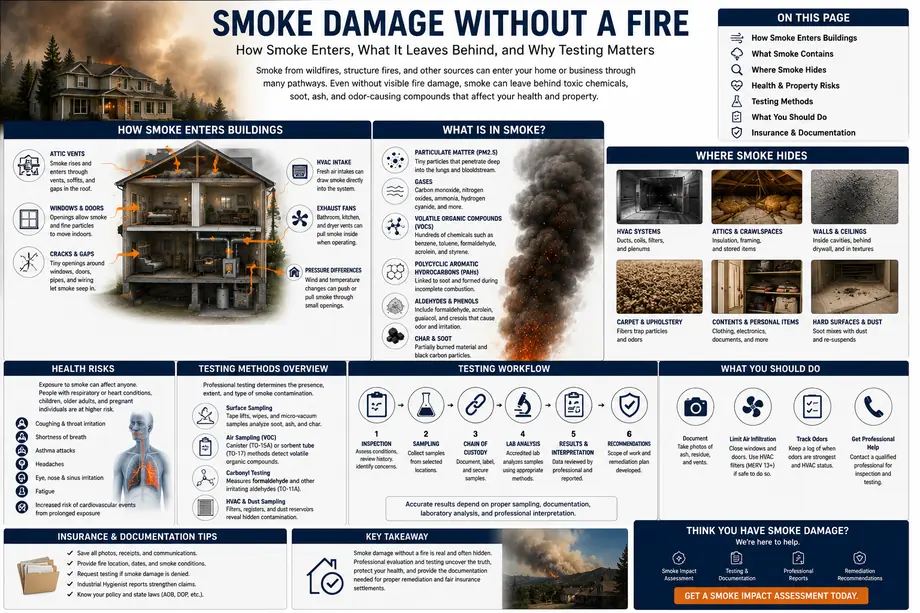
The whole picture, on one page
How smoke enters, what it leaves behind, where it hides, and how testing and documentation work. Save or share it.
Common questions
Either way, the answer is worth having.
Whether the result is "elevated" or "all clear," you'll have laboratory documentation about the home your family breathes in — with no initial out-of-pocket testing cost for qualifying insured smoke losses.